
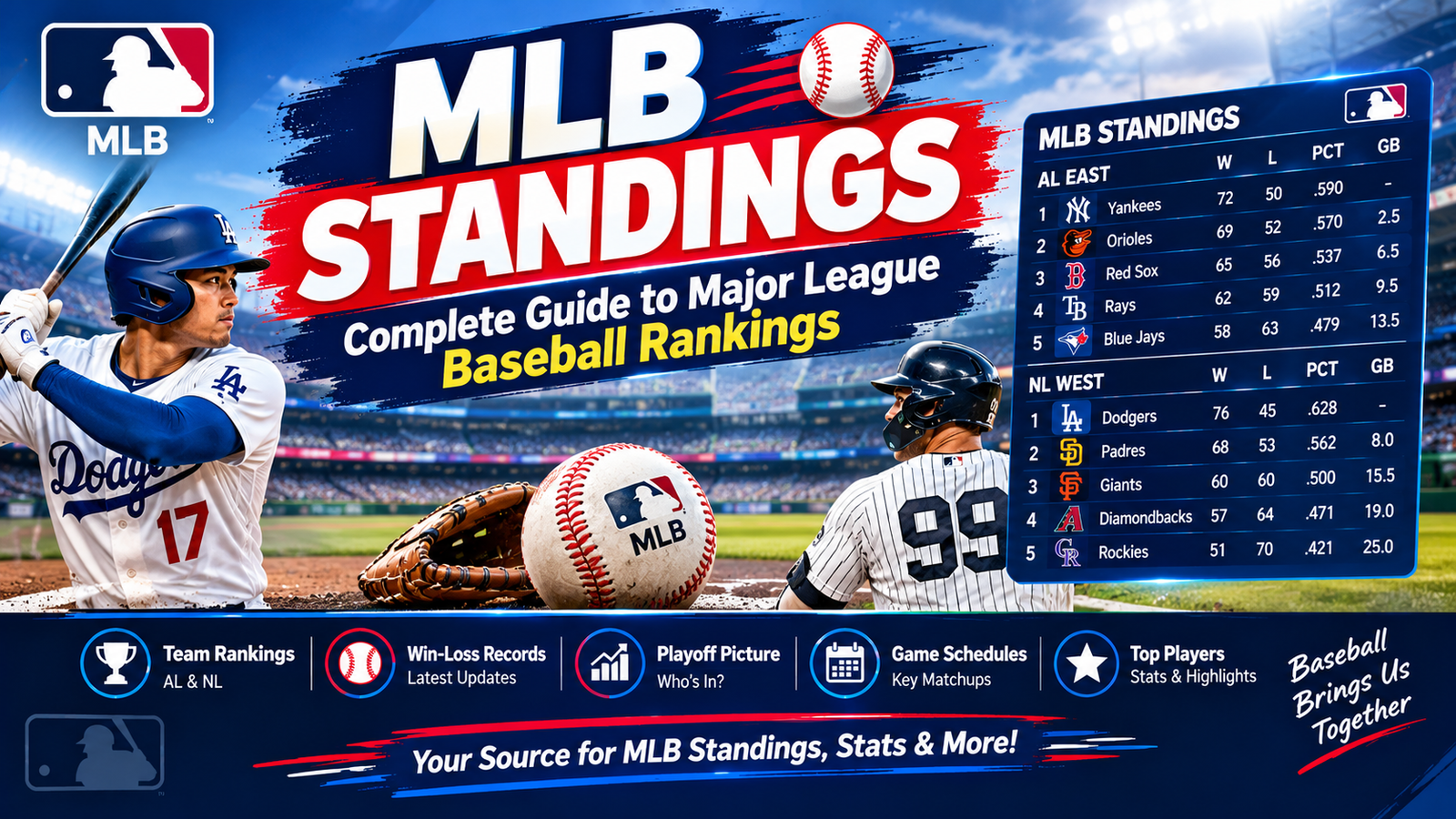
Introduction to MLB Standings
MLB Standings are an essential part of Major League Baseball, helping fans understand how their favorite teams are performing throughout the regular season. Whether you follow the New York Yankees, Los Angeles Dodgers, Boston Red Sox, or another team, checking the latest MLB standings allows you to see which clubs are leading their divisions, competing for playoff positions, and fighting to stay in the postseason race.
Major League Baseball features 30 teams divided into two leagues: the American League (AL) and the National League (NL). Each league is divided into three divisions: East, Central, and West. The standings provide an organized overview of team performance based on wins, losses, winning percentage, and other important statistics.
For baseball fans, analysts, sports writers, and fantasy baseball players, MLB standings are a valuable resource for following the competition. This guide explains how baseball standings work, what the statistics mean, and why they matter throughout the season.
What Are MLB Standings?
MLB standings are rankings that show the performance of all 30 Major League Baseball teams during a particular season. Teams are generally ranked according to their winning percentage, which is calculated by dividing the number of wins by the total number of games played.
The standings help fans identify division leaders, teams competing for Wild Card positions, and clubs that need stronger performances to remain in contention.
A typical MLB standings table includes several important statistics:
- Team: The name of the baseball club.
- W (Wins): The total number of games won.
- L (Losses): The total number of games lost.
- PCT (Winning Percentage): The proportion of games a team has won.
- GB (Games Behind): How far a team trails the division leader.
- Home Record: Performance in games played at home.
- Road Record: Performance in away games.
- RS (Runs Scored): Total runs scored by the team.
- RA (Runs Allowed): Total runs conceded to opponents.
- Streak: The team’s recent sequence of wins or losses.
These statistics give fans a clearer picture of a team’s performance beyond its position in the rankings.
How MLB Standings Are Organized
Major League Baseball has two leagues, each containing 15 teams. Both leagues are divided into three divisions with five teams in each division.
American League Standings
The American League includes the following divisions:
- AL East: Baltimore Orioles, Boston Red Sox, New York Yankees, Tampa Bay Rays, and Toronto Blue Jays.
- AL Central: Chicago White Sox, Cleveland Guardians, Detroit Tigers, Kansas City Royals, and Minnesota Twins.
- AL West: Houston Astros, Los Angeles Angels, Athletics, Seattle Mariners, and Texas Rangers.
National League Standings
The National League also has three divisions:
- NL East: Atlanta Braves, Miami Marlins, New York Mets, Philadelphia Phillies, and Washington Nationals.
- NL Central: Chicago Cubs, Cincinnati Reds, Milwaukee Brewers, Pittsburgh Pirates, and St. Louis Cardinals.
- NL West: Arizona Diamondbacks, Colorado Rockies, Los Angeles Dodgers, San Diego Padres, and San Francisco Giants.
Each division contains five teams that compete throughout the season for the best record and a stronger position in the postseason race.
How to Read the MLB Standings Table
Understanding an MLB standings table is straightforward once you know what each column represents. Wins and losses provide the basic picture, while winning percentage makes it easier to compare teams that have played different numbers of games.
For example, imagine a team has 60 wins and 40 losses. Its winning percentage is .600 because it has won 60 percent of its 100 games.
Games behind, commonly displayed as GB, indicate how far a team trails the division leader. A team with a lower GB figure is generally closer to the top of its division.
The standings may also show home and away records, recent streaks, and runs scored and allowed. These details help supporters evaluate whether a team is performing consistently or experiencing a temporary change in form.
Because standings change after games are completed, checking updated results is important when following a close division race.
Why MLB Standings Matter
MLB standings are important because they help determine which teams qualify for the playoffs and which clubs are eliminated from postseason contention.
A strong regular-season record can give a team an opportunity to win its division or secure a Wild Card position. Teams near the top of their divisions often focus on maintaining their advantage, while clubs lower in the rankings may try to improve their performance before the season ends.
Standings also create excitement for fans. A small difference in winning percentage can become significant during the final weeks of the season, particularly when several teams are competing for the same postseason position.
Sports journalists use the standings to analyze team performance, while fans use them to follow rivalries, compare clubs, and anticipate important upcoming games.
MLB Playoff Qualification Explained
Major League Baseball uses a 12-team postseason format, with six playoff teams from the American League and six from the National League.
Under the current format, each league sends its three division winners and three Wild Card teams to the postseason.
The division winners are ranked according to their regular-season records. The two division winners with the best records receive byes into the Division Series, while the remaining division winner and the three Wild Card teams begin in the Wild Card Series.
This format makes both division standings and the overall league rankings important. A team might not win its division but can still qualify for the playoffs through a Wild Card position.
As the regular season progresses, fans closely monitor the standings to see which teams are positioned to qualify and which need additional wins to improve their chances.
What Does Games Behind Mean in MLB?
Games Behind, often shortened to GB, measures the distance between a team and its division leader in the standings.
For example, if one team has 70 wins and 40 losses while another has 65 wins and 45 losses, the second team is five games behind the leader.
The calculation considers differences in both wins and losses. This statistic is useful because it provides a simple way to understand the competitive gap between teams.
A small GB number usually means a team remains close to the division leader. A larger number indicates that the team must improve its results and depend on the leader losing games to close the gap.
During the final part of the regular season, games behind becomes especially important when teams are competing for division titles or Wild Card spots.
How Winning Percentage Affects MLB Rankings
Winning percentage is one of the most important statistics in MLB standings. It represents the proportion of games a team has won and makes it possible to compare records across teams.
The formula is:
Winning Percentage = Wins ÷ (Wins + Losses)
For example, a team with 80 wins and 60 losses has a winning percentage of .571 when rounded to three decimal places.
Teams with higher winning percentages generally occupy stronger positions in the standings. However, rankings can also depend on official tiebreaking procedures when teams finish with identical records.
Winning percentage is particularly helpful when teams have played different numbers of games because of postponements, weather conditions, or scheduling differences.
Factors That Influence MLB Standings
Several factors affect a team’s position throughout the baseball season.
Team Performance
Consistent hitting, effective pitching, and strong defensive play help teams win games and improve their records.
Injuries and Player Availability
Injuries to important pitchers or everyday players can affect a team’s performance. Teams with reliable replacements may be better equipped to handle these challenges.
Strength of Schedule
Some teams face more difficult opponents during particular stretches of the season. Strong performances against competitive teams can make a meaningful difference in the standings.
Trades and Roster Changes
Teams may acquire players during the season to address weaknesses and improve their chances of competing for a playoff position.
Winning Streaks and Losing Streaks
A series of victories can help a team climb the standings, while repeated losses can reduce its chances of winning the division or qualifying for the postseason.
Where to Find Updated MLB Standings
Fans can find current MLB standings through several reliable sources. The official Major League Baseball website provides league rankings, team records, schedules, and game results.
Sports news websites and baseball statistics platforms also publish updated standings, team performance reports, and postseason projections.
When checking the standings, readers should confirm that the information reflects the latest completed games. Rankings can change daily during the regular season, making older tables unreliable for current comparisons.
For the most accurate information, use official league statistics and distinguish actual standings from projected playoff rankings or preseason predictions.
Conclusion
MLB standings are one of the best ways to follow the excitement of Major League Baseball. They show how teams perform throughout the regular season, which clubs lead their divisions, and which teams are competing for postseason opportunities.
By understanding wins, losses, winning percentage, games behind, and Wild Card positions, fans can interpret baseball rankings with greater confidence. The standings also reveal how injuries, player performances, winning streaks, and roster changes influence a team’s season.
Whether you are a casual supporter, a dedicated baseball enthusiast, or a sports content creator, keeping up with MLB standings helps you stay informed about the competition. Checking updated rankings and official statistics is the best way to follow the race toward the MLB postseason and the ultimate goal of winning the World Series.